
⚠ Bitten by a Snake? Call 911 Immediately.
The goal is to reach hospital as quickly as possible. Early treatment is directly linked to better outcomes. Stay calm, reduce movement, and call 911. Ask the dispatcher about involving the Joint Rescue Coordination Centre — the Coast Guard may be dispatched depending on your location and fastest response time. Know your dock number and GPS coordinates before you need them.
About the Massasauga Rattlesnake
The Massasauga is a small, stocky rattlesnake — adults typically reach 50–75 cm (20–30 inches). It is the only venomous snake in Ontario. Despite its reputation, the Massasauga is shy and non-aggressive; bites almost always occur when the snake is accidentally stepped on or when someone attempts to pick it up. It plays a vital role in the local ecosystem as a predator of small rodents.
In the Georgian Bay area, Massasaugas are most active from May through October. They favour rocky outcrops, sunny ledges, and shoreline areas where they can warm themselves. On cool spring and fall mornings you are most likely to find one on a sun-heated rock.
Species Identification
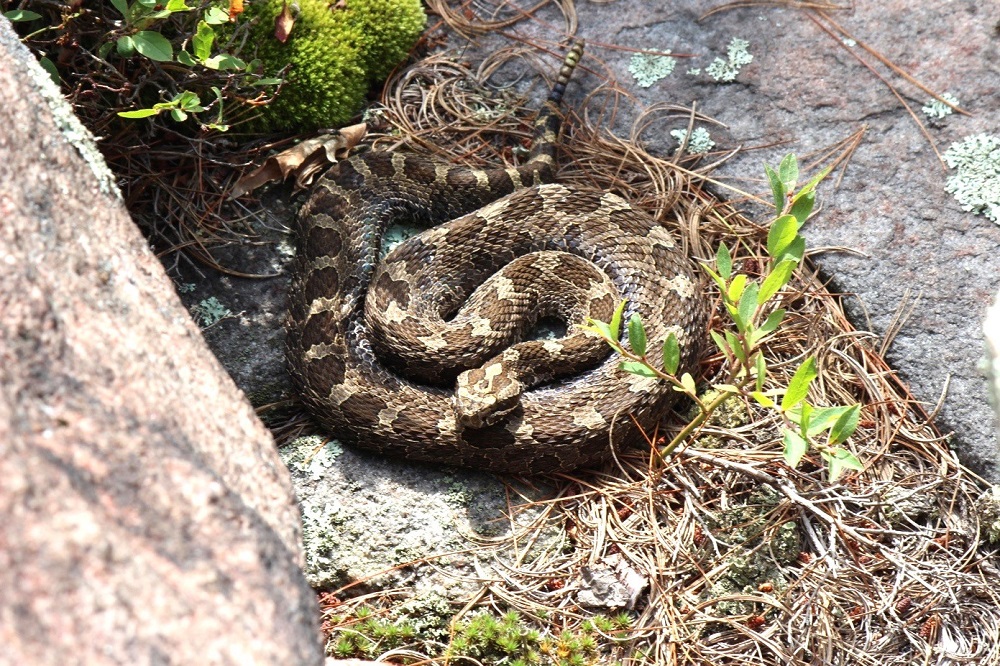
Three snake species are commonly encountered in the Cognashene area. Only one is venomous. The Eastern Fox Snake in particular is frequently mistaken for a rattlesnake — knowing the differences protects you and the harmless species. When in doubt, keep your distance from all snakes.

Benjamin Genter — CC0
- Size50–75 cm — stocky, heavy body
- HeadDistinctly triangular, broad at back
- PupilsVertical, cat-like slits
- TailRattle at tip — definitive identifier
- Heat-sensing pitVisible pit between eye and nostril
- Colour & patternGrey or light brown with dark brown blotches along back; alternating smaller blotches on sides
- BehaviourMay coil and rattle when threatened; will try to escape first


🔎 Quick Identification Key
Work through these questions in order from a safe distance:
- Does the tail tip have a rattle? → Massasauga. Venomous. Back away calmly.
- Does the snout turn up like a pig’s nose? → Eastern Hog-nosed Snake. Harmless. Ignore the dramatic hissing display.
- Is the body very large (close to a metre or more) with a copper-coloured head? → Eastern Fox Snake. Harmless. Note: it may vibrate its tail in leaves, producing a rattle-like sound.
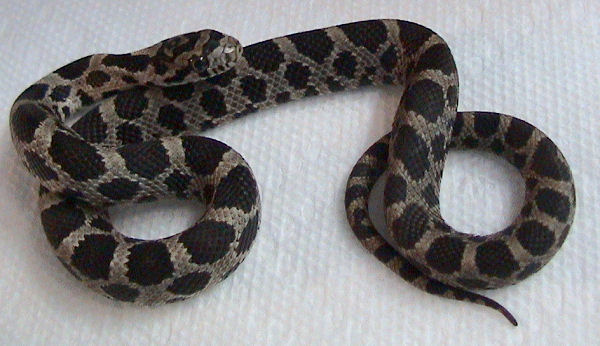
- Are the blotches outlined in black, and is there a Y or V pale mark on the head? → Eastern Milksnake. Harmless.
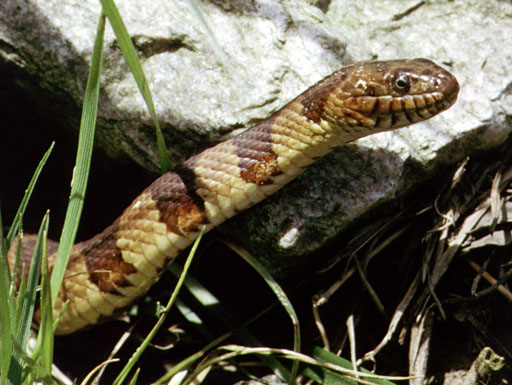
- Is it near or in the water, with crossbands near the head? → Northern Watersnake. Harmless, though it may bite if handled.
When in doubt, back away. All four harmless species are either Not at Risk, Special Concern, Threatened, or Endangered — none should ever be harmed. If you hear a rattling sound but cannot clearly confirm a rattle at the tail tip, treat the snake as a Massasauga and give it space.
Preventing a Bite
-
1
Keep paths clear
- Keep walking paths clear of brush and dense bushes so snakes are easily visible before you approach.
-
2
Wear appropriate footwear
- Wear closed shoes or boots (not sandals) when walking at night. Use a flashlight and consider carrying a stick to sweep bushes ahead of you as you walk.
-
3
Give snakes space
- If you see a snake, back away. Rattlesnakes almost only bite if startled or if they feel cornered. Never attempt to handle, move, or kill any snake.
-
4
Educate kids and guests
- Teach children and visitors what the three local snake species look like. Make sure they know what a rattle sounds like and what to do if they spot one.
-
5
Have a cottage safety plan
- Post a written safety sheet for anyone working or staying at your cottage so they know what to do if bitten. Include your dock number and GPS coordinates beside the phone.
-
6
Dress for outdoor work
- When doing yard or bush work at the cottage, wear work boots and long pants to protect the lower legs and feet — the most common bite locations.
-
7
Know your location details
- Post your dock number and the longitude and latitude of your cottage near the phone. If a rescue is needed, having this information ready significantly speeds up response time.
If You Are Bitten — What to Do
The goal is to reach hospital as quickly and safely as possible. Early treatment is directly linked to a better outcome.
-
1
Move away from the snake
- Back away calmly. Do not attempt to catch, photograph close-up, or harm the snake.
-
2
Stay calm
- Panic and rapid movement increase heart rate and can accelerate venom circulation. Keep the victim as still and calm as possible.
-
3
Call 911 immediately
- Ask the dispatcher about involving the Joint Rescue Coordination Centre. The decision to send the Coast Guard is based on your location and which emergency service has the fastest response time.
- Give your dock number and GPS coordinates immediately — this information will speed up your rescue considerably.
-
4
Reduce movement of the bitten limb
- If possible, do not move the part of the body where you were bitten. Have someone carry the victim to the dock rather than having them walk.
-
5
If alone, stay by the phone
- Do not attempt to travel alone. Stay near a telephone or radio and wait for emergency services.
-
6
Remove tight clothing and jewellery
- Remove rings, watches, bracelets, and tight clothing from the affected limb. Swelling can begin quickly and constrictive items become dangerous.
-
7
Wash the bite gently
- Gently wash the bite area with soap and water if available.
-
8
Keep the victim warm
- Keep the bite victim warm while waiting for help.
-
9
Immobilize the limb
- Place the bitten limb at or below the level of the heart, or have the victim lie down flat.
What NOT to Do
- DO NOT apply ice or a tourniquet — ice does not neutralize venom and a tourniquet can cause serious tissue damage.
- DO NOT cut or apply suction to the bite area — this is ineffective and causes additional injury.
- DO NOT try to capture or kill the snake — this puts more people at risk and delays getting the victim to hospital.
- DO NOT assume it was a “dry bite” — even if the victim feels no immediate symptoms, go to hospital. A dry bite (no venom injected) can only be confirmed through blood tests.